Generative AI has reshaped industrial operations by creating synthetic data for modeling and generating realistic images and predictive model structures. GANs and VAEs stand out as the most widely used generative methods for data creation today. Although their data generation capabilities are standard, their structural principles for training and application implementation remain distinctive. The article presents an extensive analysis comparing GANs and VAEs through their unique characteristics, benefits, and issues, along with their practical applications, to assist you in choosing between these generative AI models.
 The industrial foundation of innovation today rests specifically on Generative AI, which enables change in the healthcare and entertainment sectors and e-commerce. The training data enables generative models to develop pattern recognition and produces synthetic information that duplicates original examples. The technology has created three main applications: synthetic human facial generation, dataset enhancement, and medication development.
GANs and VAEs represent the most commonly used generative models because they apply different benefits depending on their underlying architecture and operational characteristics. The choice of generative model relies heavily on comprehending how each differs from the others to match the requirements of your particular application.
Ian Goodfellow's creation of Generative Adversarial Networks (GANs) in 2014 marked their widespread global recognition because they produce high-quality synthetic data. GANs include two interconnected neural networks and a generator network that produces fake data.
An adversarial process occurs when the generator attempts to deceive the Discriminator into labeling its created outputs as plain data. The adversarial nature of Generator-Discriminator training leads to the gradual development of better realistic output generation capabilities in the Generator model.
The probabilistic Variational Autoencoder system learns to convert input data into latent representations, which it then utilises for new output sample generation. VAEs determine the quality of generated output by using reconstruction loss, while GANs deploy a different evaluation method.
The decision between GANs and VAEs for generative AI needs a balanced evaluation of their key elements.
GANs generate photographic-quality images that work well in gaming systems and advertising purposes. VAE output graphics display coherence while showing minimal detail, making them easier to use for anomaly detection applications in scientific fields.
The training process for GANs becomes difficult due to hyperparameter sensitivity, while mode collapse and training instability frequently occur. VAE training is less complex and requires less computational power throughout.
VAEs facilitate researchers' interpretation of latent space representations for understanding feature distribution within datasets through their interpretable nature, while GANs present a black-box architecture, which makes them challenging to interpret.
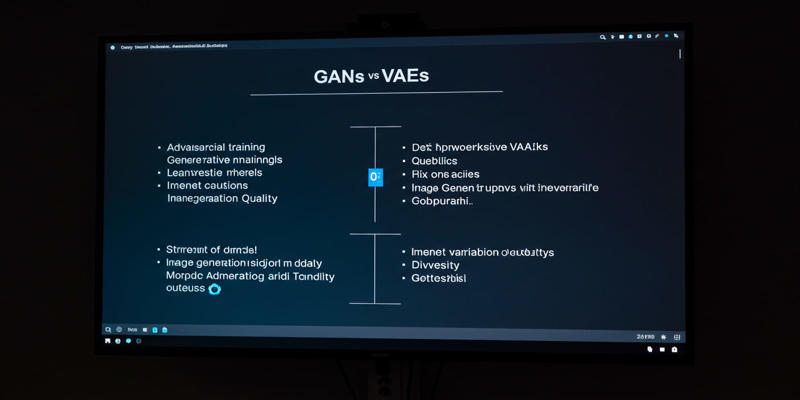 Scientific studies investigate how researchers integrate GAN and VAE features to acquire key benefits without accepting their weak points.
For example:
A range of business sectors utilise both GANs and VAEs for their operations.
GANs produce artificial medical imageries for diagnostic model education by keeping healthcare records from direct exposure. VAEs evaluate medical scan anomalies by assessing latent feature distributions in their systems.
GANs generate real-looking video game characters and film worlds, whereas VAEs personalise content delivery by applying modeled user preferences to latent spaces.
The combination of GAN systems produces improved product visual presentations through style transfer and text-to-image generation, while VAEs use latent representation compression to anticipate customer patterns.
The selection between GANs and VAEs relies on your project's intended objectives. GANs should be used in cases requiring maximum output quality since they excel in creative and visual applications. Scientific research involving anomaly detection and interpretability needs, together with stability and reduced computational needs, should opt for VAEs. Deciding how generative AI will benefit businesses requires enterprises to recognise both the capabilities and boundaries of these systems to achieve maximum results.
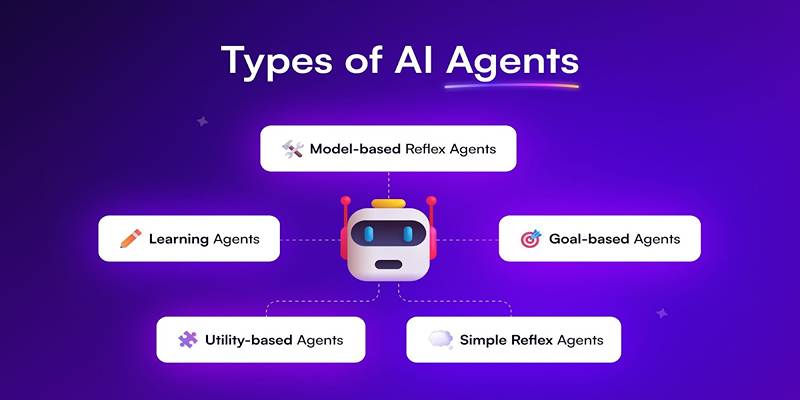
Learn about the main types of AI agents in 2025 and how they enable smart, autonomous decision-making systems.

AI in drug discovery is transforming medical research by speeding up drug development, reducing costs, and enabling personalized treatments for patients worldwide

How AI APIs from Google Cloud AI, IBM Watson, and OpenAI are helping businesses build smart applications, automate tasks, and improve customer experiences

Drive more traffic with ChatGPT's backend keyword strategies by uncovering long-tail opportunities, enhancing content structure, and boosting search intent alignment for sustainable organic growth

Master the Alation Agentic Platform with the API Agent SDK capabilities, knowing the advantages and projected impact.

Learn to excel at prompt engineering through 12 valuable practises and proven tips
Master how to use DALL-E 3 API for image generation with this detailed guide. Learn how to set up, prompt, and integrate OpenAI’s DALL-E 3 into your creative projects

How to set upstream branch in Git to connect your local and remote branches. Simplify your push and pull commands with a clear, step-by-step guide

AI and the Metaverse are shaping the future of online communication by making virtual interactions smarter, more personal, and highly engaging across digital spaces
Every aspect of OpenAI's GPT-4.5, which presents better conversational performance alongside improved emotional awareness abilities and enhanced programming support and content creation features

Discover how autonomous robots can boost enterprise efficiency through logistics, automation, and smart workplace solutions

YouTube channels to learn SQL, The Net Ninja, The SQL Guy